What Is SEO vs GEO vs AEO? Understanding the Future of Digital Marketing

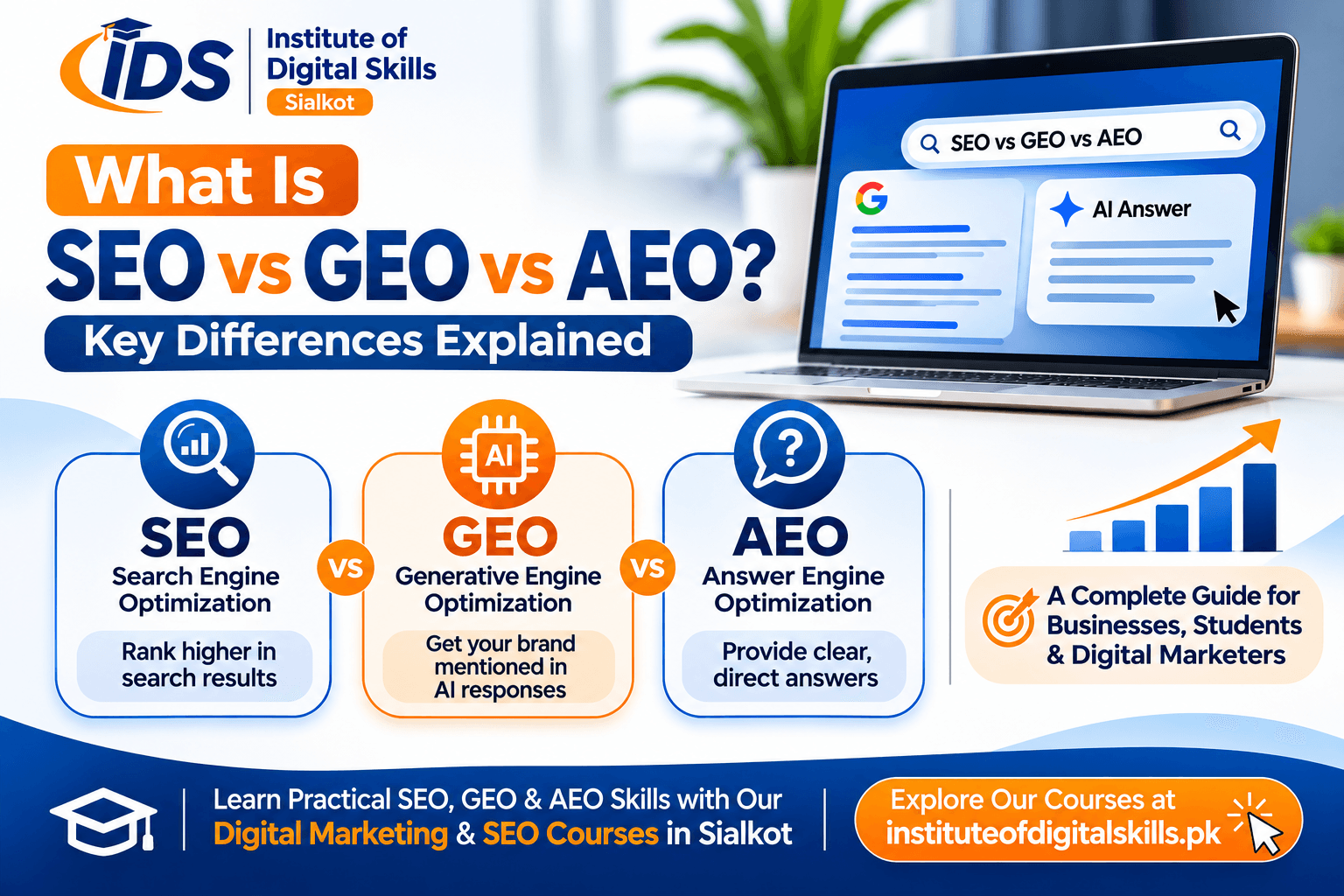
The way people search for information online is changing rapidly. In the past, most people used Google to find websites, compare information, and discover businesses. Today, users are also asking questions directly through AI platforms such as ChatGPT, Google Gemini, and Perplexity.
This change has introduced three important digital marketing concepts: SEO, GEO, and AEO.
SEO (Search Engine Optimization) helps websites improve their visibility in traditional search results. GEO (Generative Engine Optimization) focuses on improving brand and content visibility in AI-generated responses. AEO (Answer Engine Optimization) helps content become easier for search engines and AI-powered platforms to understand and present as direct answers.
For students, freelancers, website owners, and business professionals, understanding these three strategies is becoming an important part of modern digital marketing.
Let’s explore how they work, their differences, and how businesses can use them together.
What Is SEO (Search Engine Optimization)?
SEO stands for Search Engine Optimization. It is the process of improving a website’s content, structure, and technical performance to increase its visibility in organic search engine results.
The main objective of SEO is to attract relevant visitors from search engines such as Google and Bing without paying for every click.
For example, when someone searches for “Digital Marketing Course in Sialkot”, a properly optimized website can appear in Google’s organic results and attract potential students.
SEO includes three major areas:
- On-Page SEO: Optimizing page titles, headings, keywords, URLs, images, content, and internal links.
- Off-Page SEO: Building website authority through relevant backlinks, brand mentions, and online reputation.
- Technical SEO: Improving website speed, mobile usability, indexing, crawling, security, and website structure.
A successful SEO strategy combines useful content, keyword research, search intent, and a good user experience.
If you want to understand digital marketing from the beginning, read our guide: A Beginner’s Guide to Digital Marketing: Basics, Pros, and Cons.
What Is GEO (Generative Engine Optimization)?
GEO stands for Generative Engine Optimization. It is the practice of improving website content and brand credibility so that generative AI platforms can discover, understand, and potentially reference your information in their responses.
Unlike traditional search engines, generative AI platforms can combine information from multiple sources to generate conversational answers.
Examples include:
- ChatGPT
- Google Gemini
- Perplexity AI
- Microsoft Copilot
- Google’s AI search experiences
Imagine someone asks an AI platform:
“Which institute offers practical digital marketing training in Sialkot?”
An institute with useful educational content, clear course information, consistent business details, and credible online references may have a better opportunity to appear in relevant AI-generated answers.
Important GEO practices include:
- Publishing original and informative content.
- Demonstrating real industry knowledge and experience.
- Maintaining consistent business information online.
- Earning relevant backlinks and brand mentions.
- Organizing content with descriptive headings.
- Providing accurate and trustworthy information.
GEO is not about adding AI-related keywords everywhere. It is about making your website a useful and credible information source.
What Is AEO (Answer Engine Optimization)?
AEO stands for Answer Engine Optimization. It focuses on structuring website content so that search engines and answer-oriented platforms can easily identify and understand direct answers to users’ questions.
People increasingly search using complete questions, such as:
- What is SEO?
- How does GEO work?
- What is the difference between SEO and AEO?
- How can beginners learn digital marketing?
AEO helps businesses create content that directly answers these questions.
Important AEO techniques include:
- Writing clear answers immediately after question-based headings.
- Using descriptive H2 and H3 headings.
- Adding relevant frequently asked questions.
- Using comparison tables and bullet points.
- Implementing appropriate structured data.
- Writing simple, informative, and well-organized content.
For example, an article that clearly defines AEO immediately after the heading “What Is AEO?” may be suitable for a featured snippet or another answer-focused search experience. However, search engines decide which content appears.
SEO vs GEO vs AEO: What Is the Difference?
Although SEO, GEO, and AEO have different objectives, they work together to improve online visibility.
| Feature | SEO | GEO | AEO |
|---|---|---|---|
| Full Form | Search Engine Optimization | Generative Engine Optimization | Answer Engine Optimization |
| Main Goal | Improve search rankings | Improve AI visibility | Provide direct answers |
| Platforms | Google, Bing | ChatGPT, Gemini, Perplexity | Featured Snippets, AI answers |
| Content Focus | Keywords and search intent | Expertise and credibility | Questions and clear answers |
| Success Measurement | Rankings and organic traffic | AI mentions and citations | Answer visibility |
In simple terms:
- SEO helps people discover your website.
- GEO helps AI platforms discover and reference your brand.
- AEO helps your content become a useful direct answer.
These strategies are complementary rather than competing approaches.
How to Optimize Your Website for SEO, GEO, and AEO
Businesses do not need three completely separate marketing strategies. A well-planned content strategy can support all three.
1. Understand Search Intent
Research what your target audience wants to know. Create content around genuine questions, problems, and relevant search terms rather than simply repeating keywords.
2. Publish Helpful and Original Content
Write detailed articles with practical explanations, examples, and useful information. Avoid copying content from competitors.
3. Use Clear Headings and Content Structure
Organize articles using descriptive H2 and H3 headings. Include short definitions, comparison tables, bullet points, and relevant FAQs.
4. Build Website Authority
Publish consistently, earn relevant backlinks, maintain accurate business profiles, and demonstrate genuine industry knowledge.
5. Improve Technical SEO
Make sure your website is mobile-friendly, secure, fast, crawlable, and properly indexed. Use descriptive image ALT text and relevant internal links.
6. Monitor Your Performance
Use Google Search Console and analytics tools to monitor impressions, clicks, search queries, and organic traffic. You can also observe whether your brand appears in relevant AI-generated responses.
For a deeper understanding of these skills, explore our Digital Marketing Course in Sialkot, where students learn practical digital marketing concepts, including SEO, content optimization, and online promotion.
Which Is More Important: SEO, GEO, or AEO?
The best approach is not to choose only one. Start with SEO because it provides the technical and content foundation for online visibility. Then apply AEO techniques to make your content easier to understand and extract as answers. Finally, strengthen GEO through original expertise, brand authority, and credible online references.
If you want to learn website optimization in greater depth, explore our SEO Course in Sialkot. It introduces students to keyword research, on-page SEO, off-page SEO, backlinks, and Google ranking strategies.
For complete marketing knowledge, our Digital Marketing Course in Sialkot also provides a practical learning pathway for students, freelancers, and business owners.
Conclusion
SEO, GEO, and AEO represent the changing landscape of online discovery. SEO helps websites earn visibility in traditional search results, AEO makes information easier to present as direct answers, and GEO focuses on visibility within generative AI responses.
For digital marketers, website owners, and business professionals, understanding these three concepts is becoming increasingly valuable.
At the Institute of Digital Skills (IDS Institute), Sialkot, students can develop practical digital marketing knowledge and understand how modern search optimization strategies support business growth in an increasingly AI-driven world.
Explore our Digital Marketing Course or SEO Training Course to learn these skills through structured training.
Frequently Asked Questions (FAQs)
SEO focuses on traditional search rankings, GEO focuses on brand mentions and citations in AI-generated responses, and AEO focuses on making content suitable for direct answers.
No. GEO is not replacing SEO. Strong technical SEO, useful content, and website credibility remain important foundations for visibility in AI-powered search experiences.
Yes. AEO-oriented content can help search engines understand questions and answers. Clear, helpful content may be eligible for featured snippets and AI-powered search experiences, although appearance is not guaranteed.
Yes. A website can earn Google rankings and also be referenced by AI platforms. However, ranking on Google does not guarantee that ChatGPT or another AI tool will mention the website.
Beginners should start with keyword research, on-page SEO, technical SEO, content optimization, structured data, and search intent. They can then develop practical skills in answer-focused content and AI search visibility.