
How to Learn AI in Pakistan: A Practical Beginner’s Roadmap 2026

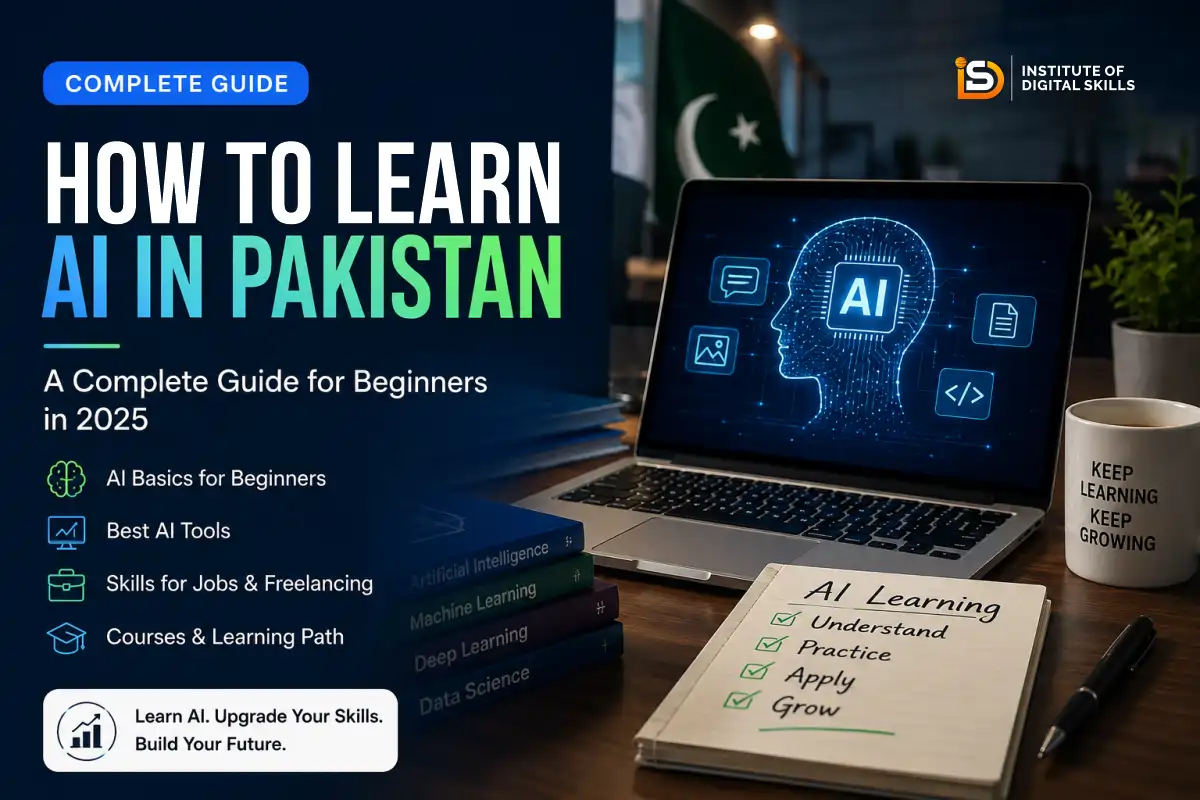
Artificial Intelligence (AI) is rapidly changing how people study, work, create content and run businesses. In Pakistan, learning practical AI skills can help students, freelancers, job seekers and business owners improve productivity and adapt to the growing use of AI in different industries.
However, learning AI does not necessarily mean becoming a machine learning engineer or spending years studying advanced mathematics and programming. Beginners can start by learning how modern AI tools work, using generative AI, writing effective prompts and applying AI to everyday tasks.
The key is knowing where to start and which skills to learn first. Instead of trying to learn every AI tool available, beginners should follow a structured learning path and gradually move from basic concepts to practical applications.
In this guide, you will learn how to learn AI in Pakistan from scratch, which AI skills and tools to focus on, whether you need coding or mathematics, and how AI can be used for studies, freelancing, jobs and business.
What Is Artificial Intelligence?
Artificial Intelligence (AI) is technology that enables computers and software to perform tasks that normally require human intelligence, such as understanding language, recognizing patterns, analyzing information, generating content and solving problems.
Modern AI includes technologies such as machine learning, generative AI and natural language processing. Tools such as ChatGPT, Google Gemini and Claude allow people to use AI for writing, research, productivity, content creation and many other everyday tasks.
For beginners, learning AI does not mean understanding every technical detail immediately. Start by understanding what AI can do, where it can be useful and how it can be applied to real-world tasks.
Why Should You Learn AI in Pakistan?
AI is becoming a useful skill across education, freelancing, digital marketing, e-commerce, design, office work and many other fields. Learning how to use AI effectively can help you complete repetitive tasks faster, improve the quality of your work and explore new career opportunities.
Improve Your Productivity
AI tools can help with tasks such as research, summarizing information, generating ideas, drafting content, organizing information and creating documents. Learning how to use these tools properly can save time and make everyday work more efficient.
Develop Skills for Freelancing
Freelancers can use AI to support services such as content creation, graphic design, video production, research, digital marketing and virtual assistance. AI does not replace the need for professional skills, but it can help freelancers work more efficiently and offer additional services.
Stay Competitive in the Job Market
Employers are increasingly interested in people who can use modern digital tools effectively. Adding practical AI skills to your existing professional skills can make you more adaptable and help you work with AI-assisted tools in your field.
Support Business Growth
Business owners can use AI for market research, content creation, customer communication, product descriptions, data analysis and other repetitive tasks. Understanding AI can help businesses identify where automation and AI-assisted workflows can save time and resources.
Prepare for Future Opportunities
AI is developing quickly, and new tools and applications continue to emerge. Learning the fundamentals and developing the ability to adapt to new AI tools can be more valuable than learning one specific tool alone.
For beginners in Pakistan, the goal should not be to learn every AI technology available. Instead, focus on practical skills that are relevant to your studies, profession, business or career goals.
Who Should Learn AI?
AI is not limited to programmers or technology professionals. Anyone who regularly works with information, content, customers, data or digital tools can benefit from learning practical AI skills.
Students
Students can use AI to support research, understand difficult concepts, organize study material, summarize information and improve productivity. Learning AI early can also help students develop digital skills that may be useful in future education and careers.
Freelancers
Freelancers can use AI to improve workflows for content writing, graphic design, video editing, digital marketing, research and virtual assistance. AI skills can help freelancers complete repetitive tasks faster while focusing more on quality and creativity.
Job Seekers
People looking for jobs can learn AI tools that are relevant to their target profession. For example, someone working in marketing can learn AI-assisted content creation and research, while an office professional can use AI for documents, data organization and productivity.
Business Owners
Business owners can use AI for customer communication, marketing ideas, product descriptions, research, business analysis and repetitive administrative tasks. Understanding practical AI applications can help them identify opportunities to improve business processes.
Digital Marketers and Creators
Digital marketers, graphic designers, video editors and content creators can use AI to generate ideas, speed up research, create drafts and experiment with different types of content.
Professionals
Professionals in areas such as sales, administration, education, e-commerce and customer service can learn AI tools that complement their existing expertise.
The important point is that you do not need to become an AI engineer to benefit from AI. Start with the AI skills that are directly relevant to your current work, studies or career goals.
How to Learn AI From Scratch in Pakistan
If you are completely new to Artificial Intelligence, start with practical concepts and gradually build your skills. You do not need to learn advanced programming or machine learning on your first day.
Step 1: Understand AI Fundamentals
Start by learning the basic concepts behind Artificial Intelligence. Understand what AI is, how machine learning differs from traditional software, what generative AI means and how modern AI tools produce text, images, audio and other content.
You do not need to memorize technical terminology. Focus on understanding what AI can do, what its limitations are and where it can be useful.
Step 2: Learn Generative AI
Once you understand the basics, explore generative AI tools that can create or transform content.
Practice using AI to:
- Generate and improve text
- Summarize information
- Brainstorm ideas
- Analyze documents
- Create images
- Generate presentations
- Assist with research
The goal is to learn through practical tasks rather than simply watching tutorials.
Step 3: Master Prompt Engineering
Learning how to communicate effectively with AI is an important practical skill. A well-structured prompt can provide better context, instructions and desired output than a short and unclear request.
Practice writing prompts that clearly explain the task, provide relevant context and specify the format or result you need.
Step 4: Learn AI Productivity Tools
Apply AI to tasks you already perform in your studies, job or business.
For example, you can use AI to organize information, draft emails, summarize meetings, create content outlines, research topics and assist with repetitive work.
Step 5: Learn AI for Content and Design
If you work in marketing, design or content creation, explore AI tools for writing, image generation, video creation, editing and creative ideation.
Combine AI with your existing professional skills instead of relying on AI to produce everything automatically.
Step 6: Learn AI Automation
After becoming comfortable with individual AI tools, learn how different tools can work together to automate repetitive workflows.
For example, a business could use automation to collect customer information, organize it, generate a response and send the information to the appropriate system.
Step 7: Build Practical AI Projects
The best way to strengthen your AI skills is to use them in real projects. Create something related to your field, such as an AI-assisted content workflow, marketing campaign, research system, business chatbot or productivity workflow.
Projects help you understand how AI works in real situations and give you practical examples that you can demonstrate to employers or clients.
Step 8: Learn Responsible AI Use
As you become more comfortable with AI, learn how to evaluate AI-generated information, protect sensitive data and recognize the limitations of AI tools.
AI can produce incorrect, incomplete or misleading information, so important information should always be verified. You should also understand when human judgment is necessary and avoid entering confidential business, personal or financial information into AI tools without reviewing their privacy practices.
Responsible AI use is an important skill for students, freelancers, professionals and business owners.
AI Learning Roadmap for Beginners in Pakistan
Month 1: AI Fundamentals and Prompting
Learn the basics of Artificial Intelligence, generative AI and prompt engineering. Practice using AI chat assistants for research, writing, learning and productivity.
Month 2: Practical AI Tools
Learn AI tools for content creation, image generation, video editing, presentations, research and everyday productivity.
Month 3: Apply AI to Your Career
Choose a specific direction such as digital marketing, graphic design, freelancing, e-commerce, office work or business. Build practical projects using AI in that field.
After 3 Months: Choose Your Specialization
Once you understand practical AI, decide whether you want to continue with AI productivity and automation or move toward technical areas such as Python, data science, machine learning and AI development.
Can You Learn AI Without Coding?
Yes. You can learn and use many AI tools without writing a single line of code. Many beginners can start using practical AI tools without prior programming experience and use AI to improve productivity, create content, conduct research, automate routine tasks and support their work or studies.
Today’s AI tools are designed for everyday users. By learning how to write effective prompts and use AI responsibly, you can complete many tasks without understanding complex algorithms or programming languages.
What You Can Learn Without Coding
You can learn to:
- Write effective AI prompts
- Use AI chat assistants
- Create content with AI
- Generate images and presentations
- Summarize documents
- Analyze PDFs and spreadsheets
- Automate repetitive tasks using no-code tools
- Improve productivity with AI
These skills are valuable for students, freelancers, digital marketers, designers, business owners and office professionals.
When Do You Need Coding?
Programming becomes important if you want to build AI applications, develop machine learning models, create AI software or work as an AI engineer or data scientist.
In those career paths, you may eventually learn:
- Python
- Machine Learning
- Deep Learning
- Data Science
- Neural Networks
- TensorFlow or PyTorch
- APIs and AI Development
However, these are advanced topics and are not required to start learning AI.
Start With Practical AI Skills
For most beginners, the best approach is to first learn how AI can solve real problems in daily work. Once you become confident using AI tools, you can decide whether you want to continue into programming and advanced Artificial Intelligence development.
Learning practical AI first makes it easier to understand where coding adds value and whether it aligns with your career goals.
Best AI Tools for Beginners
Beginners do not need to learn dozens of AI tools at once. Start with a small set of reliable tools and learn how to use them for real tasks.
AI Chat Assistants
- ChatGPT
- Google Gemini
- Claude
AI Image Generation
- ChatGPT image generation
- Google Gemini
- Adobe Firefly
AI Video
- Runway
- CapCut
- Canva
AI Writing & Research
- ChatGPT
- Claude
- Gemini
AI Automation
- Zapier
- Make
How Should Beginners Choose AI Tools?
Do not choose tools simply because they are popular. Select tools based on the work you actually need to perform.
For example:
- Students: research, summaries and study assistance
- Freelancers: content, design, research and productivity
- Marketers: content, advertising ideas and research
- Designers: image generation and creative ideation
- Business owners: customer support, research and automation
- Office professionals: documents, data and repetitive tasks
AI tools change quickly, so focus on learning how to solve problems with AI rather than memorizing a list of specific tools. The ability to adapt to new tools will remain useful as AI technology continues to evolve.
| AI Tool | Best For | Beginner Friendly |
|---|---|---|
| ChatGPT | Writing, research, productivity | Yes |
| Google Gemini | Research, writing, Google ecosystem | Yes |
| Claude | Writing and document analysis | Yes |
| Canva | Design and visual content | Yes |
| CapCut | AI-assisted video editing | Yes |
| Zapier | Workflow automation | Intermediate |
How Students Can Use AI
AI can be a useful learning assistant for students when it is used to support understanding rather than replace genuine learning. Students can use AI to organize information, explain difficult concepts and improve their study workflow.
Research and Topic Exploration
Students can use AI to brainstorm ideas, identify important concepts and create a starting point for researching a topic. Information should still be verified using reliable sources, especially for academic work.
Understand Difficult Concepts
If a topic is difficult to understand, students can ask AI to explain it in simpler language, provide examples or break a complex concept into smaller steps.
Create Study Notes
AI can help organize lengthy information into summaries, bullet points, revision notes and study outlines. Students should review the generated material to make sure important information has not been missed or misunderstood.
Practice Questions
Students can ask AI to create practice questions, quizzes and hypothetical problems based on a subject they are studying. This can help them identify areas where they need more practice.
Improve Writing
AI can help students review grammar, sentence structure and clarity. It can also suggest ways to improve an existing draft while allowing the student to retain ownership of the work.
Learn New Skills
Students can use AI as a learning assistant when developing skills such as digital marketing, graphic design, programming, communication and research.
Use AI Responsibly
Students should not blindly copy AI-generated answers into assignments or use AI to misrepresent work they did not complete themselves. AI-generated information can also contain errors, so important facts should be checked before being used.
The most effective approach is to use AI as a learning assistant, while continuing to develop independent thinking, research and problem-solving skills.
How Freelancers Can Use AI
AI can help freelancers work faster, improve their workflow and offer more value to clients. However, successful freelancers should use AI as a productivity tool rather than depend on it to replace their professional skills.
Content Writing
Freelancers can use AI to brainstorm topics, create content outlines, improve drafts, summarize information and generate different content ideas.
The final content should still be reviewed, edited and fact-checked before being delivered to a client.
Graphic Designing
AI can help designers generate creative concepts, explore visual ideas, create backgrounds and speed up parts of the design process.
Professional design knowledge remains important for typography, composition, branding, editing and creating designs that meet a client’s requirements.
You can develop these professional design skills through our Graphic Designing Course in Sialkot.
Digital Marketing
Digital marketers can use AI for audience research, content ideas, campaign planning, ad copy variations, keyword research and reporting.
AI can speed up the preparation process, but marketers still need to understand strategy, targeting, analytics and customer behavior.
If you want to develop digital marketing skills alongside AI, explore our Digital Marketing Course in Sialkot.
Video Editing and Content Creation
AI-powered tools can assist with captions, transcripts, voiceovers, video ideas, editing and other repetitive tasks. Freelancers can use these features to reduce production time and focus on creative decisions.
Virtual Assistance and Research
Virtual assistants can use AI to summarize documents, organize information, draft emails, prepare reports and assist with repetitive administrative tasks.
Build AI-Assisted Freelancing Services
Instead of simply offering “AI services,” freelancers can combine AI with a specific professional skill.
For example:
- AI-assisted content writing
- AI-powered social media management
- AI-assisted graphic design
- AI-supported market research
- AI video content creation
- AI automation services
This approach allows freelancers to provide a useful business outcome rather than simply selling access to an AI tool.
Don’t Depend Entirely on AI
Clients still expect accuracy, originality, communication and professional results. AI-generated output can contain errors or lack the context needed for a specific project.
The most valuable freelancers will be those who know how to combine AI with their existing skills, experience and judgment.
How Businesses Can Use AI
AI can help businesses reduce repetitive work, improve productivity and make better use of information. Small businesses in Pakistan can start with simple AI applications without investing in complex AI systems.
Marketing and Content Creation
Businesses can use AI to generate content ideas, draft social media posts, create product descriptions, prepare email campaigns and develop marketing concepts.
AI can speed up content production, but businesses should review and customize the output to match their brand voice and customers.
AI is also becoming an important part of social media marketing, from content planning and caption writing to audience research and ad copy. Learn more through our Social Media Marketing Course in Sialkot.
AI can also help exporters with market research, content creation and international customer acquisition. Learn more about digital marketing for export businesses in Pakistan.
Customer Support
AI can assist with frequently asked questions, basic customer inquiries and support workflows. Businesses can use AI to prepare responses and organize customer information while keeping human support available for more complicated issues.
Market Research
AI can help businesses organize information, analyze customer feedback, summarize market research and identify potential trends.
AI-generated findings should be checked against reliable information before making important business decisions.
E-commerce
Online stores can use AI for product descriptions, customer communication, content creation, product recommendations and other repetitive e-commerce tasks.
For businesses selling through platforms such as Shopify, AI can support different parts of store management and marketing. If you want to learn how to build and manage a Shopify store, explore our Shopify Course in Sialkot.
If you are planning to build your own online store, read our guide on how to start a Shopify store in Pakistan.
Business Documents and Administration
AI can assist with drafting emails, creating reports, summarizing meetings, organizing information and preparing routine documents.
This can save time for employees who regularly perform repetitive administrative tasks.
Data Analysis
Businesses can use AI-assisted tools to explore spreadsheets, identify patterns, summarize data and generate insights. However, sensitive business information should only be entered into AI services after reviewing the platform’s privacy and data-handling practices.
AI Automation
Businesses can connect AI with other software to automate repetitive workflows. For example, an organization might automate parts of lead management, customer communication, reporting or internal information processing.
The best way to introduce AI into a business is to start with a specific problem. Identify a repetitive or time-consuming task, determine whether AI can improve it, test the workflow and measure the results before expanding it across the business.
AI should support employees and business processes, not be introduced simply because it is a popular technology.
Businesses involved in exporting can also combine AI with digital marketing to support market research, content creation and international customer acquisition. Read our guide to Digital Marketing for Export Businesses in Pakistan.
AI Skills for Jobs and Freelancing in Pakistan
AI skills can complement existing professional skills and create new opportunities for people working in Pakistan. However, learning AI does not mean that everyone needs to become an AI engineer. The right skills depend on your career goal and existing experience.
AI Skills for Office Jobs
Office professionals can learn AI-assisted productivity skills such as document creation, research, data organization, email drafting, presentations and report preparation.
These skills can help employees complete routine tasks more efficiently while spending more time on important responsibilities.
AI Skills for Digital Marketing
Digital marketers can use AI for content ideas, audience research, keyword research, campaign planning, ad copy and marketing analysis.
Combining AI with knowledge of SEO, social media marketing, advertising and analytics can make these skills more valuable in the workplace and freelance market.
AI Skills for Graphic Designers
Designers can use AI for creative ideation, image generation, background creation and other parts of the design workflow.
However, professional knowledge of design principles, branding, typography and tools such as Photoshop or Illustrator remains important.
AI Skills for Content Creators
Content creators can learn AI-assisted writing, image generation, video creation, voice tools, research and content planning.
The ability to combine AI with storytelling, editing and audience understanding can help create better content.
If you want to develop professional video editing skills alongside AI, explore our Video Editing Course in Sialkot.
AI Skills for Freelancers
Freelancers can combine AI with existing services to improve their productivity or develop new service offerings.
For example:
- AI-assisted content creation
- AI-powered social media services
- AI-assisted research
- AI video production
- AI graphic design
- AI automation
- AI-supported virtual assistance
AI can also support e-commerce workflows such as product research, listing preparation and customer communication. If you are interested in selling internationally, explore our eBay Course in Sialkot.
AI Skills for Technical Careers
People who want to pursue technical AI careers will need a deeper learning path that may include Python, mathematics, statistics, data science, machine learning and deep learning.
This path is different from learning practical AI tools for productivity and business.
Build AI Skills Around Your Existing Profession
One of the most effective approaches is to combine AI with a skill you already have.
For example, a digital marketer who learns AI can use it to improve marketing workflows. A designer can use AI to speed up creative production, while an office professional can use AI for documents and data-related tasks.
The future value of AI is not simply knowing how to use one particular tool. It is understanding how to apply AI to solve real problems within your profession.
How Long Does It Take to Learn AI?
The time required to learn AI depends on what you want to achieve. Learning practical AI tools for everyday work can take much less time than becoming an AI or machine learning professional.
Learning AI Tools as a Beginner
If your goal is to use AI for productivity, content creation, research or everyday tasks, you can start learning the basics within a few weeks through regular practice.
Focus on understanding AI tools, writing effective prompts and applying them to real tasks.
Developing Practical AI Skills
Becoming comfortable with generative AI, prompt engineering, AI productivity tools, content creation and automation may take several months of consistent practice.
At this stage, focus on completing practical projects rather than simply watching tutorials.
Preparing for an AI Career
If you want to work as an AI developer, machine learning engineer or data scientist, expect a much longer learning journey.
You may need to study:
- Python
- Mathematics and statistics
- Data science
- Machine learning
- Deep learning
- Neural networks
- AI development frameworks
- Real-world projects
This can take many months or longer depending on your previous technical knowledge and the career level you want to reach.
Practice Matters More Than Speed
There is no fixed amount of time required to “finish” learning AI. AI tools and technologies continue to evolve, so learning AI is an ongoing process.
A better approach is to set a specific goal, learn the skills needed for that goal and practice them through real projects.
For example, a student may focus on AI for learning and productivity, while a freelancer may focus on AI-assisted services and automation. Someone pursuing a technical AI career will need a much deeper learning path.
The more consistently you practice solving real problems with AI, the faster you can turn theoretical knowledge into useful skills.
AI is also changing how freelancers find clients and deliver services. Read our guide on whether freelancing is still worth it in Pakistan after AI.
Do You Need Mathematics or Programming to Learn AI?
No, you do not need advanced mathematics or programming skills to start learning practical AI tools. The requirements depend on the type of AI skills you want to develop.
For Practical AI and Generative AI
If your goal is to use tools such as AI chat assistants, image generators, writing tools and productivity applications, you can begin without programming.
You mainly need to learn:
- How AI tools work at a basic level
- Prompt engineering
- How to evaluate AI-generated information
- AI-assisted research
- AI productivity workflows
- Responsible use of AI
For AI-Powered Freelancing and Business
Freelancers, marketers, designers and business owners can also learn practical AI applications without becoming programmers.
You can use AI for content creation, marketing, design, research, customer support and automation while continuing to build expertise in your chosen profession.
When Programming Becomes Important
Programming becomes more important if your goal is to develop AI applications, build machine learning models or pursue a technical AI career.
You may eventually need to learn:
- Python
- Statistics
- Mathematics
- Data structures
- Machine learning
- Deep learning
- APIs
- AI development frameworks
When Mathematics Becomes Important
Advanced mathematics is not necessary for most beginner-level AI applications. However, mathematics and statistics become increasingly important when you move into machine learning, data science and AI model development.
For most beginners, the best approach is to start with practical AI skills and decide later whether you want to move into the technical side of Artificial Intelligence.
The important thing is to choose your learning path according to your goal rather than assuming that you must learn programming and advanced mathematics from the beginning.
How to Choose an AI Course in Pakistan
If you decide to take a structured AI course instead of learning entirely through self-study, choose a course based on what you actually want to achieve.
Check the Course Syllabus
A good beginner AI course should clearly explain what you will learn. Depending on your goals, the syllabus may include AI fundamentals, generative AI, prompt engineering, AI tools, productivity, content creation, automation or technical AI concepts.
Avoid choosing a course simply because it has “AI” in its title. Make sure the topics match your career or learning goals.
Look for Practical Training
AI is best learned through practice. Look for a course that includes real exercises, assignments and projects instead of only theoretical lectures.
Practical training can help you understand how to apply AI to real tasks and develop confidence using different tools.
Consider Your Current Skill Level
Beginners should choose a course that starts from the fundamentals rather than jumping directly into advanced machine learning or programming.
If you already have technical knowledge, you may prefer a more advanced course covering Python, machine learning, data science or AI development.
Check Whether Coding Is Required
Not every AI course is designed for programmers. If your goal is AI productivity, generative AI, content creation, marketing or business applications, look for a course that matches those requirements.
If you want to become an AI developer or machine learning professional, choose a technical program that includes programming and related subjects.
Consider the Learning Format
Think about whether you learn better through classroom training, online lessons or a combination of both.
For students and beginners who need guidance, instructor-led training can provide opportunities to ask questions, receive feedback and practice under supervision.
Check Trainer and Institute Experience
Before enrolling, research the trainer or institute offering the course. Look for information about their experience, course structure, practical training and previous students.
Do not select a course based only on advertisements or claims about future income.
Choose Skills That Remain Useful
AI tools change quickly, so a good course should teach more than a list of currently popular applications.
Look for training that teaches transferable skills such as prompt engineering, AI-assisted problem solving, evaluating AI output, workflow design and responsible AI use.
Choose a Course Based on Your Goal
The best AI course is the one that matches what you want to do with AI.
For example:
- Students: AI for learning and productivity
- Freelancers: AI-assisted services and automation
- Digital marketers: AI for content, SEO and advertising
- Designers: AI-assisted creative workflows
- Business owners: AI for marketing, research and business processes
- Technical learners: Python, machine learning and AI development
Before paying for any AI course in Pakistan, compare the syllabus, practical training, instructor experience, duration and learning format. This will help you choose a program that provides useful skills rather than simply following the latest AI trend.
Frequently Asked Questions About Learning AI in Pakistan
Can I learn AI without coding?
Yes. Beginners can learn practical AI skills such as generative AI, prompt engineering, AI productivity and AI-assisted content creation without programming. Coding becomes important if you want to move into technical AI development or machine learning.
How long does it take to learn AI?
It depends on your goal. You can learn basic AI tools and practical applications within a few weeks, while developing advanced technical AI skills can take many months or longer.
Is AI difficult to learn for beginners?
AI does not have to be difficult if you start at the right level. Beginners can first learn practical AI tools and concepts before moving into advanced subjects such as programming, machine learning and deep learning.
Do I need mathematics to learn AI?
You do not need advanced mathematics to start using practical AI tools. Mathematics and statistics become more important when you move into machine learning, data science and technical AI development.
Which AI skills should beginners learn first?
Start with AI fundamentals, generative AI, prompt engineering and AI productivity tools. You can then move into AI for content creation, design, automation or technical AI depending on your goals.
Can students use AI for studying?
Yes. Students can use AI to explain difficult concepts, create study notes, generate practice questions, organize information and support research. They should verify important information and use AI responsibly rather than submitting AI-generated work as their own.
Can AI help freelancers earn money?
AI can help freelancers improve services such as content writing, graphic design, digital marketing, video production, research and virtual assistance. However, professional skills, quality, communication and client requirements remain important.
Is an AI course worth taking in Pakistan?
A structured AI course can be useful if you want guided learning, practical projects, instructor support and a clear learning path. Before enrolling, compare the syllabus, practical training, instructor experience and course format.
Which AI tools should I learn?
The right tools depend on your goal. Beginners can start with AI chat assistants, research and productivity tools, image and video tools, writing tools and no-code automation platforms.
Can I learn AI from home?
Yes. You can learn AI through online courses, tutorials, documentation, practical projects and self-study. Classroom training can also be useful if you prefer direct instructor guidance and structured practice.
Conclusion
Learning AI in Pakistan does not require you to become a programmer or AI engineer from the beginning. You can start with practical AI skills such as generative AI, prompt engineering, productivity tools and AI-assisted workflows, then move toward advanced technical skills if they match your career goals.
The most effective approach is to learn AI through practical use. Start with the tasks you want to improve, choose the tools that can help, practice regularly and build real projects around your studies, profession, freelancing work or business.
AI is developing quickly, so the goal should not be to memorize every new tool. Instead, focus on understanding how AI can solve real problems and learn skills that remain useful as technology changes.
If you are looking for structured training and want to learn practical AI skills with guidance, you can explore our AI Course in Sialkot and start building the skills needed to use Artificial Intelligence more effectively.



One thought on “How to Learn AI in Pakistan: A Practical Beginner’s Roadmap 2026”
Comments are closed.