Etsy’s New AI Policy Update 2026: What Sellers Need to Know

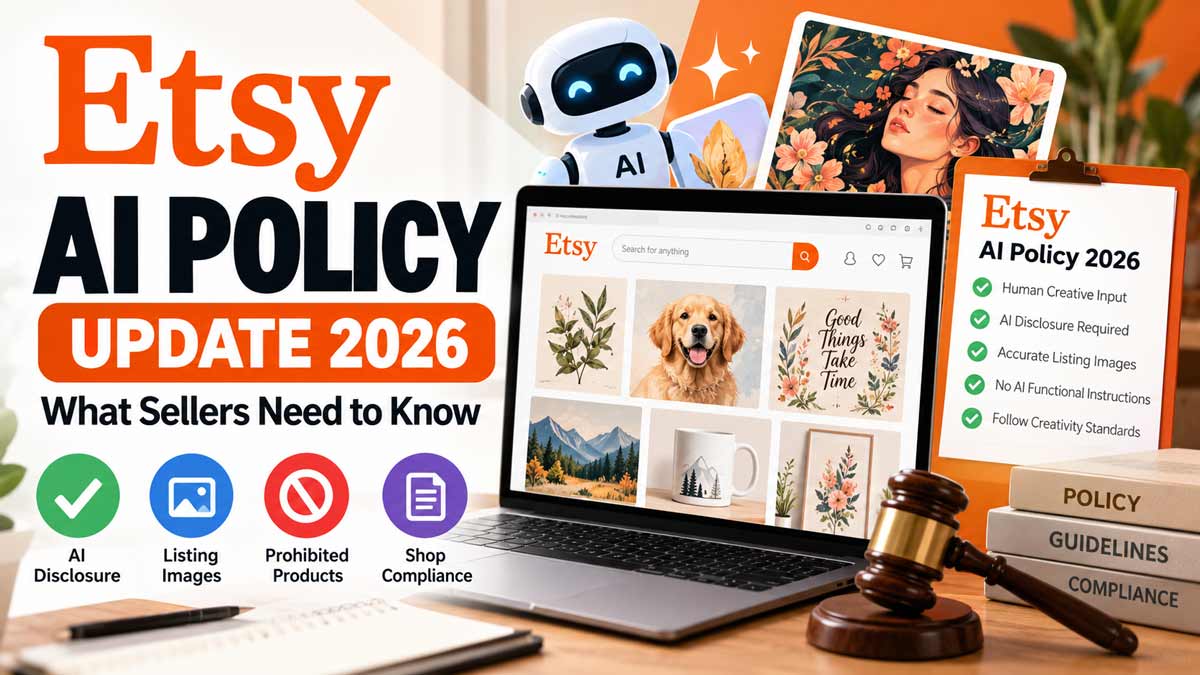
The Etsy AI policy explains how sellers can use artificial intelligence to create and sell eligible products on Etsy. In 2026, sellers need to understand the rules for AI-generated artwork, human creative input, disclosure, listing images, and prohibited content. This guide explains the key requirements, practical examples, and steps sellers can take to keep their shops compliant.
Etsy sellers are increasingly using artificial intelligence (AI) to create digital artwork, personalized products, product mockups, and marketing content. However, Etsy has clarified its expectations for AI use through a policy update published on October 22, 2026.
The updated guidance focuses on original human creativity, transparent AI disclosure, accurate product images, and restrictions on certain AI-generated products. Sellers who use AI for digital downloads or personalized artwork should understand these requirements before creating new listings or updating existing products.
In this guide, we explain Etsy’s latest AI policy update, what sellers can and cannot sell, how listing images should be handled, and what practical steps Etsy sellers can take to protect their shops.
If you are learning how to build an online selling business, you can also explore the Etsy Course in Sialkot at IDS Institute to learn about product research, listing optimization, Etsy SEO, and online selling strategies.
What Is Etsy’s New AI Policy Update?
On October 22, 2026, Etsy published updated guidance explaining how sellers can use AI while maintaining the marketplace’s focus on creativity, authenticity, and buyer trust.
The policy does not introduce a complete ban on AI-generated artwork. Instead, Etsy continues to allow certain seller-prompted AI creations while setting clearer limits on automated content, AI-generated functional instructions, and misleading product images.
According to Etsy’s official guidance, sellers must make meaningful creative contributions to the products they offer. Simply using automation to generate products or listings at scale without individualized human involvement does not meet the platform’s expectations.
Read Etsy’s official announcement here: What Is Etsy’s Stance on AI Creations?
Are AI-Generated Designs Still Allowed on Etsy?
Yes. Etsy continues to allow eligible AI-assisted creations when sellers contribute original ideas, provide individualized prompts, curate the output, and comply with the platform’s other policies.
For example, a seller may use AI tools to develop an original fantasy illustration or create a personalized pet portrait based on a customer’s requirements. The seller should remain involved in the creative process rather than relying entirely on automated generation.
However, permission to use AI does not mean every AI-generated product automatically qualifies for sale on Etsy. Sellers must still follow the applicable Creativity Standards, intellectual property rules, and product-specific requirements.
Examples of Potentially Permitted AI Creations
- Original digital artwork developed using the seller’s own ideas and prompts.
- Personalized AI-assisted portraits created in response to a buyer’s request.
- AI-assisted illustrations that the seller reviews, selects, and refines.
- Original designs created with AI support and offered as eligible digital products.
Important: Sellers must disclose AI use in the listing description when an item is created with AI, as required by Etsy’s guidance.
If you want to improve your design skills and learn how to develop original visual products, explore the Professional Graphic Designing Course in Sialkot.
What AI-Generated Content Is Not Allowed on Etsy?
Etsy’s updated guidance identifies several types of AI-related content that sellers should avoid.
1. Fully Bot-Generated Products and Listings
Etsy prohibits entirely bot-generated AI content that lacks individualized human prompting, curation, and creative input. Mass automation that generates products or listings without meaningful human oversight is also prohibited.
For example, automatically producing hundreds of generic designs and publishing them through scripts without reviewing or creatively directing each item can violate Etsy’s expectations.
Sellers should make individual creative decisions, check the quality of their work, and ensure that every listing accurately describes the product being sold.
2. AI-Generated Functional Instructions
Etsy does not allow functional instructions generated using AI. This category includes content primarily intended to teach a buyer how to complete a specific task or achieve a particular result.
Examples include:
- Knitting, crochet, sewing, and embroidery patterns.
- Recipes and cooking instructions.
- Building and woodworking plans.
- Assembly or instruction manuals.
- Step-by-step instructional guides and how-to e-books.
This restriction is important for digital product sellers who sell downloadable files. Before publishing a product, check whether it is artwork or a functional guide intended to instruct the buyer.
3. Standalone AI Prompt Bundles
Etsy prohibits selling AI prompt bundles separately from the finished artwork they help create.
For instance, a seller should not assume that a downloadable collection of prompts for generating images is an eligible Etsy product simply because the prompts relate to creative work.
Review Etsy’s official AI creations guidance before listing AI-related digital products.
Etsy’s New Rules for AI Listing Images
Product images play a major role in online shopping because buyers rely on them to understand what they will receive. Etsy has clarified its image requirements to reduce misleading representations and improve buyer trust.
For most products, a listing must include at least one unedited photo of the actual item against a real background. Some exceptions apply depending on the product category and listing type.
AI-assisted editing may be used for other listing images when the final result accurately represents the real product. However, sellers must not use AI to make an item appear materially different from what the buyer will receive.
What Sellers Should Do
- Include the required unedited photo of the actual product.
- Use accurate colors, textures, dimensions, and product details.
- Avoid AI edits that hide defects or change the product’s actual appearance.
- Use digital previews that accurately represent the downloadable file.
- Check the specific image requirements for the product category before publishing.
For example, a seller offering a physical mug should not use an AI-generated image that makes the mug look different in size, color, or finish from the actual item.
For a digital artwork download, the preview should accurately represent the artwork included in the purchase.
Read the official Etsy Listing Image Requirements for the full rules and applicable exceptions.
Copyright and Trademark Risks Still Matter
Using AI does not automatically remove copyright, trademark, privacy, or publicity concerns. Sellers remain responsible for ensuring that their products comply with Etsy’s applicable policies and do not infringe another person’s rights.
For example, using a famous character, a protected logo, or another creator’s distinctive artwork without the necessary rights can create problems even if an AI tool helped produce the design.
Before listing a product, sellers should:
- Review the design for recognizable protected characters, logos, and brand elements.
- Avoid copying another seller’s artwork or listing images.
- Confirm that they have the rights and permissions needed to use relevant assets.
- Read Etsy’s Creativity Standards and other applicable policies.
Developing original designs and maintaining clear records of your creative process can help you build a more sustainable online business.
What Should Existing Etsy Sellers Do Now?
If you already operate an Etsy shop, you do not necessarily need to remove every product made with AI. Instead, review your existing listings and determine whether each one complies with the updated requirements.
Use this practical checklist:
Step 1: Review Your AI-Generated Products
Identify products created with AI, including digital artwork, personalized designs, and other downloadable items. Check whether each product meets Etsy’s eligibility requirements.
Step 2: Check Your Listing Descriptions
Make sure the description discloses AI use when required. Keep the product description accurate and explain what the customer will receive.
Step 3: Audit Your Listing Images
Check whether your listing includes the required unedited photo of the actual product. Review additional images to ensure that AI editing has not created a misleading impression.
Step 4: Review Automated Workflows
If you use automation to produce products or publish listings, ensure that each item receives individualized human creative input and review. Do not rely on fully automated, mass-generated content.
Step 5: Remove or Correct Non-Compliant Products
If a product violates the rules, stop treating it as an eligible listing until the issue is resolved. Update or remove content as appropriate and consult Etsy’s official policy guidance.
Step 6: Improve Your Etsy Selling Skills
Policy compliance is only one part of running a successful shop. Sellers should also understand product research, keyword selection, listing titles, tags, product photography, pricing, and customer service.
The Etsy Course in Sialkot at IDS Institute is relevant for learners who want practical training in Etsy selling, digital and physical products, listing optimization, and shop marketing.
Which AI Design Products Should Sellers Review First?
If you have limited time, begin with product categories where the updated rules may have the greatest impact.
AI-generated digital artwork: Check the originality of the work, your creative contribution, required disclosure, and intellectual property compliance.
AI-assisted product mockups: Confirm that the images accurately represent the product. For most physical products, include the required unedited photo.
Downloadable patterns and instructional files: Review these carefully because Etsy prohibits AI-generated functional instructions, including patterns, recipes, manuals, and how-to guides.
Automated product collections: Check whether products were created with individualized human prompting, curation, and creative input rather than fully automated generation.
Products using brand names or recognizable characters: Review intellectual property risks before publishing or renewing listings.
Sellers who want to expand beyond Etsy may also benefit from learning about other online selling platforms. The Shopify Course in Sialkot can help learners understand how to build and manage an independent online store.
How Etsy Sellers Can Use AI Responsibly
AI can help sellers explore design ideas, improve productivity, and support parts of their creative workflow. The key is to use it as a tool rather than a replacement for individual creative decisions and responsible product development.
Consider these practices:
- Start with your own idea, concept, or customer requirement.
- Review and refine AI-generated results before offering them for sale.
- Disclose AI use in the listing description when required.
- Verify product details, file contents, and image accuracy.
- Avoid protected designs or assets unless you have the necessary rights.
- Keep your shop descriptions transparent and customer-focused.
- Review Etsy’s policies periodically because guidance may change.
Sellers should also learn how to bring the right customers to their products. The Digital Marketing Course in Sialkot covers relevant skills such as SEO, online promotion, and digital marketing fundamentals.
Frequently Asked Questions About Etsy’s AI Policy Update 2026
No. Etsy continues to allow eligible seller-prompted AI creations when sellers provide individualized creative input, curate the results, disclose AI use as required, and follow other applicable policies.
Yes. Etsy’s guidance requires sellers to disclose in the listing description when an item is created using AI.
Eligible AI-assisted artwork may be sold when it meets Etsy’s requirements, including meaningful human creative involvement, disclosure, originality, and compliance with intellectual property rules.
Etsy prohibits functional instructions generated using AI. This includes categories such as craft patterns, recipes, manuals, project plans, and instructional guides.
AI-assisted editing may be used on additional listing images as long as the images remain accurate and do not mislead buyers. For most products, Etsy requires at least one unedited photo of the actual item against a real background.
Standalone AI prompt bundles are prohibited under Etsy’s updated guidance. Sellers should consult the official policy before listing products related to AI prompts.
Etsy may remove listings that violate its rules. Severe or repeated violations can lead to additional enforcement action, including permanent shop closure.
You can explore the Etsy Course in Sialkot at IDS Institute to learn about Etsy shop setup, product research, listing optimization, Etsy SEO, and online selling strategies.
Final Thoughts
Etsy’s October 2026 AI policy update does not mean that sellers must stop using AI. Instead, it clarifies the importance of original human creativity, transparency, accurate listing images, and compliance with product eligibility requirements.
Sellers should review their AI-assisted products, update descriptions where necessary, check listing images, and avoid prohibited content such as AI-generated functional instructions and standalone AI prompt bundles.
A successful Etsy business requires more than creating products. Understanding marketplace rules, researching demand, optimizing listings, and marketing products effectively are all important parts of long-term growth.
If you want to develop practical online selling and marketing skills, explore the courses offered by IDS Institute, including the Etsy Course in Sialkot, Shopify Course, and Digital Marketing Course.
Stay informed, create responsibly, and always check Etsy’s official policies before publishing or updating your listings.